tabula
closed beta · v0.2.1 · gypsum

one app to track them all.

the nearly-everything app.

habits, mood, sleep, water, workouts, books, medication, and more, together in one calm place on mac and iphone.

  • no account
  • no ads or tracking
  • ai that stays on your device
  • your own private icloud
join the closed betaabout tabula
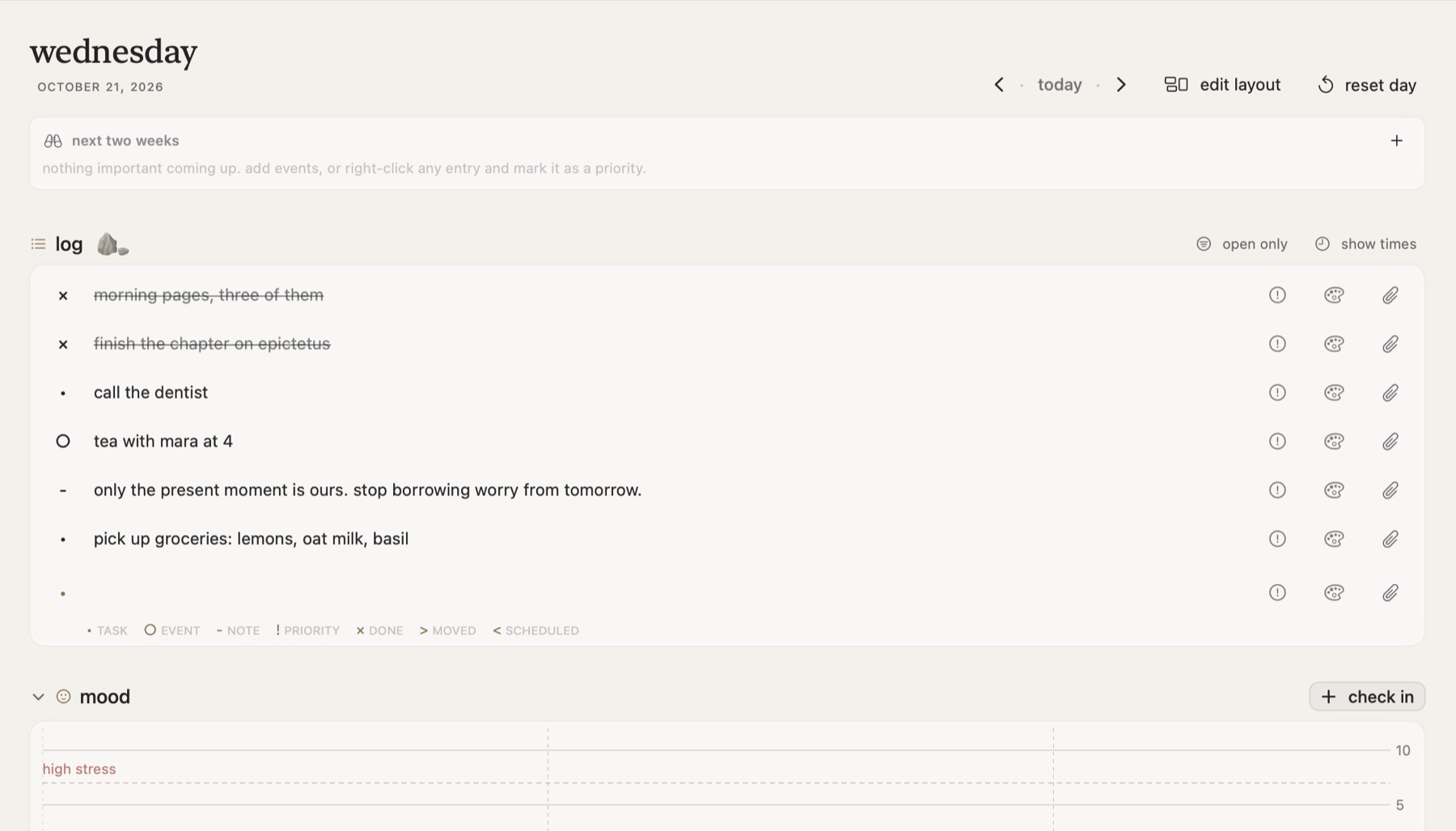
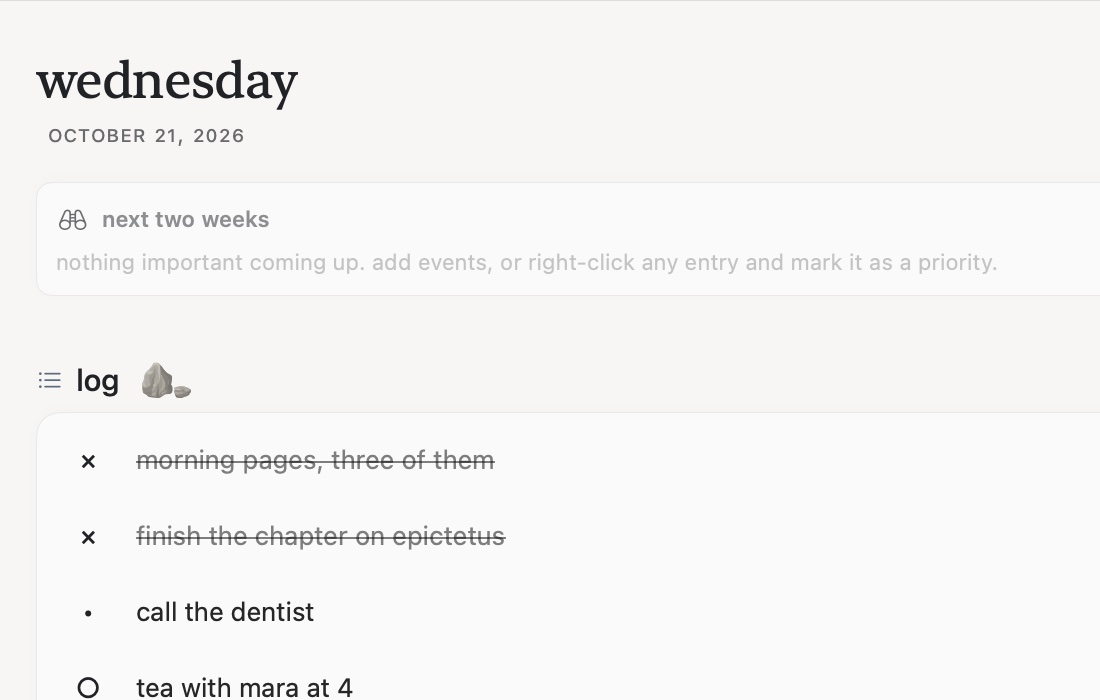
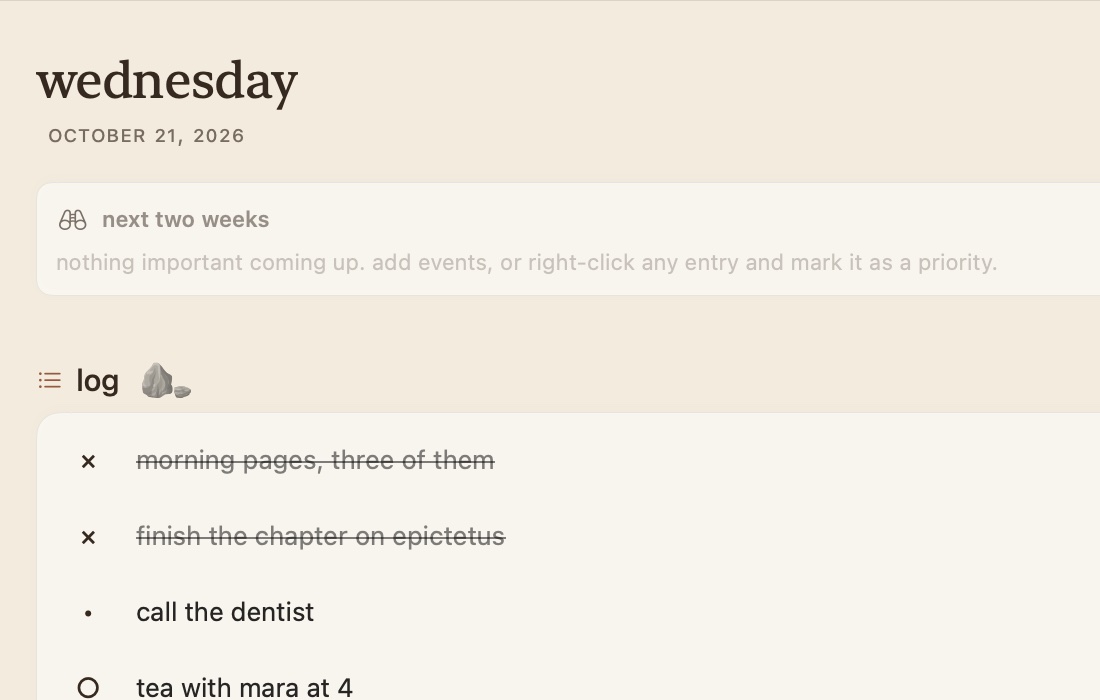
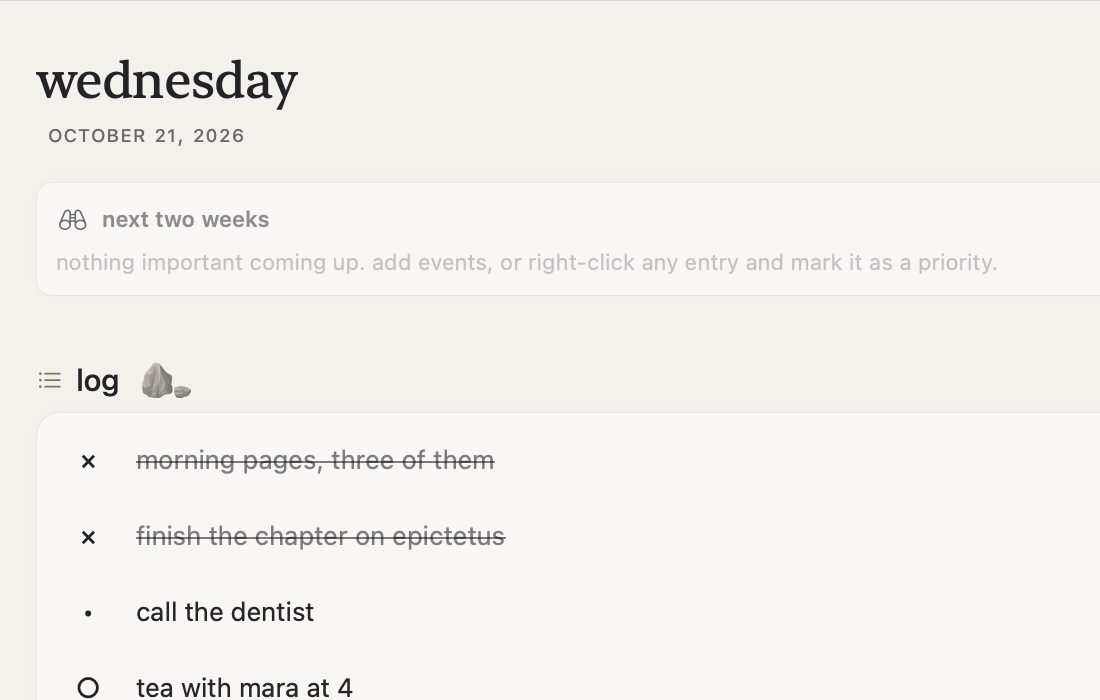
tabula on mac: today's log with tasks, events, and notes
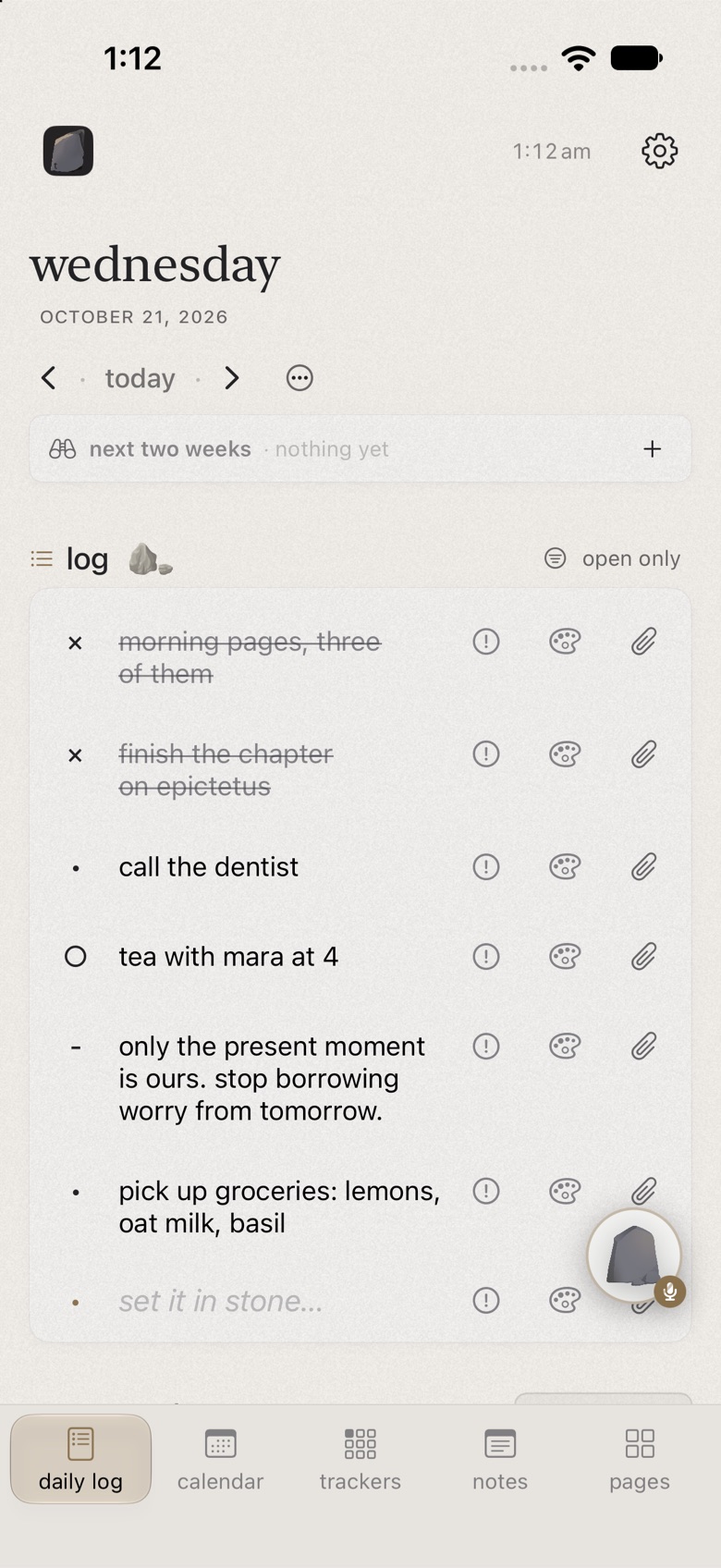
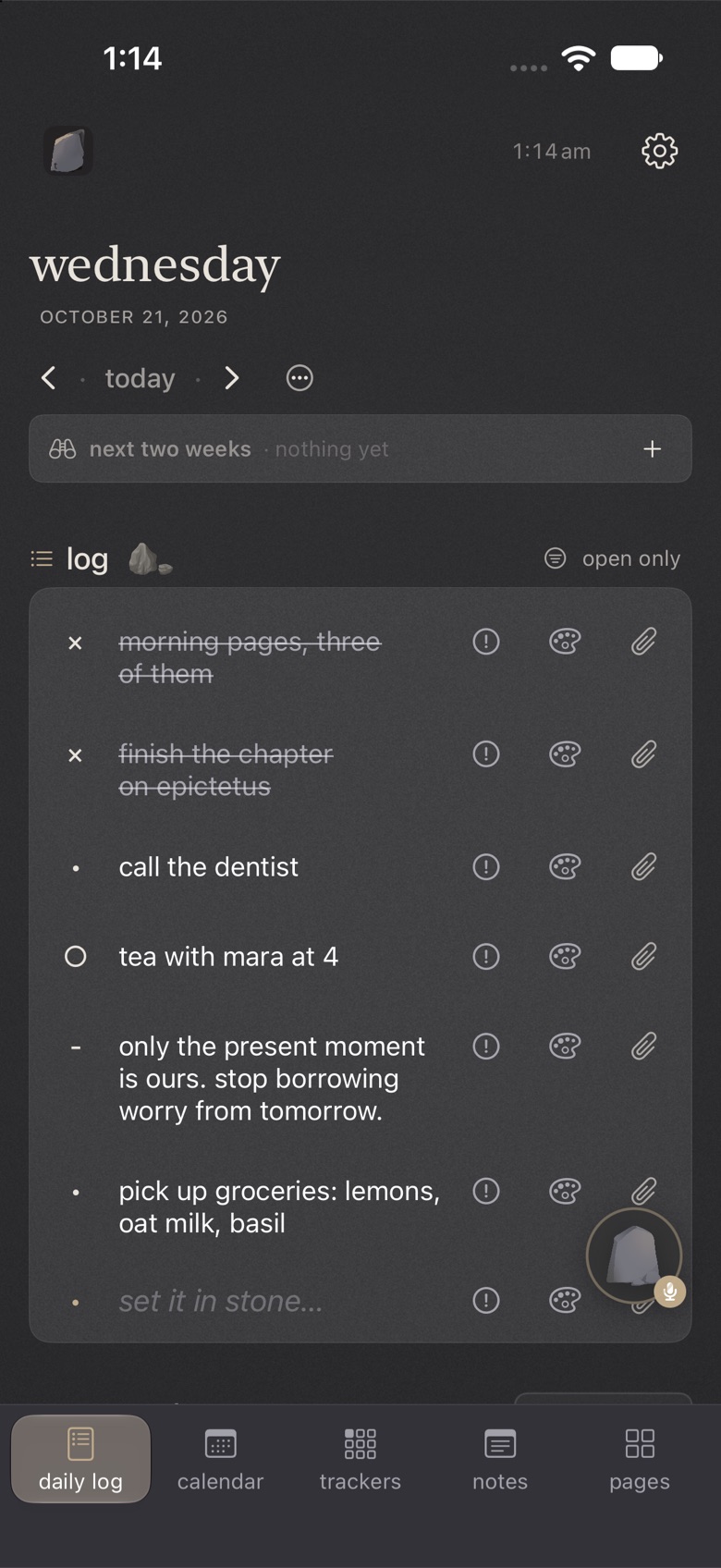
tabula on iphone: today's log and trackers

a blank slate, on purpose

tabula is latin for a writing tablet: the wax kind that could be smoothed clean and written on again. that idea is the heart of the app. every day opens blank, and you decide what goes on it.

it's shaped by stoic philosophy too: pay attention to what's in your control, look back honestly on the day, and let the rest go. the daily log, the mood check-ins, and the annals are all built for that small evening habit of reflection.

the other reason is practical. there are so many apps that track just one thing: one for habits, one for water, one for sleep, one for mood, one for workouts, one for books. i got tired of juggling fifty of them, so i built a single app that does all of it, and does each part properly. you only need one.

private by design

no server on our side, so your journal has nowhere to go.

no account

nothing to sign up for

your own icloud

sync only to your private icloud

ai on your device

and you can turn it off

no ads, no selling

anonymous counts, if you opt in

only lookups leave your device (weather, books, shows), never your journal. full privacy policy.

intelligence that stays home

both run on your device, never a server. turn either off if you'd rather not.

oratio

say your day, and it sorts it into trackers, tasks and events

the oracles

pythia, hestia and diogenes read your tarot and i ching (aurum)

oratio never logs a question or something you didn't do. if a reading mentions self-harm, tabula stops and shows where to find help.

built on research

how studies shaped tabula. it's a journal, not a treatment.

tracking alone rarely helps strong

mood monitoring on its own barely changes symptoms; adding brief skills does (Astill Wright et al., 2026; Everitt et al., 2021)

so tabula: never claims tracking treats anything.
small skills help moderate

small planned activities, reappraisal and breathwork can help, though single techniques are mixed (Bralee et al., 2025; Fincham et al., 2023; Morello et al., 2023)

so tabula: offers one optional skill after a heavy check-in.

streaks and points don't help moderate

gamification doesn't make mental health apps work better or keep people longer (Liu et al., 2025; Six et al., 2021)

so tabula: no streaks, points or red "missed".

stepping away is normal moderate

people lapse and come back as part of normal tracking (Epstein et al., 2015)

so tabula: welcomes you back, with nothing to catch up on.

effort makes people stop strong

check-ins drop off as logging takes more effort (Astill Wright et al., 2026; Liu et al., 2025)

so tabula: one tap or one sentence, and only the reminders you choose.

adhd needs scaffolds early

adults with adhd want quiet, flexible support over pressure (Chen et al., 2026; Deshmukh, 2025)

so tabula: focus helpers: fewer choices, one thing at a time.

references
  • Astill Wright, L., Shajan, G., Purewal, D., Stone, J., Majid, M., Guo, B.-L., & Morriss, R. (2026). Mood monitoring, mood tracking, and ambulatory assessment interventions in depression and bipolar disorder: Systematic review and meta-analysis of randomized controlled trials. JMIR Mental Health, 13, Article e84020. https://doi.org/10.2196/84020
  • Bralee, E., Mostazir, M., Warren, F. C., Newbold, A., Hulme, C., Cranston, T., Aas, B., Bear, H., Botella, C., Burkhardt, F., Ehring, T., Fazel, M., Fontaine, J., Frost, M., García-Palacios, A., Greimel, E., Hößle, C., Hovasapian, A., Huyghe, V. E., . . . Watkins, E. R. (2025). Brief use of behavioral activation features predicts benefits of self-help app on depression symptoms: Secondary analysis of a selective prevention trial in young people. Journal of Consulting and Clinical Psychology. https://doi.org/10.1037/ccp0000917
  • Chen, J.-R., Meng, Y.-B., & Nie, K.-X. (2026). "Not just me and my to-do list": Understanding challenges of task management for adults with ADHD and the need for AI-augmented social scaffolds. Proceedings of the ACM on Human-Computer Interaction, 10. https://doi.org/10.1145/3816978
  • Deshmukh, R. (2025). Toward neurodivergent-aware productivity: A systems and AI-based human-in-the-loop framework for ADHD-affected professionals. In Proceedings of the 16th Biannual Conference of the Italian SIGCHI Chapter. Association for Computing Machinery. https://doi.org/10.1145/3750069.3750114
  • Epstein, D. A., Ping, A., Fogarty, J., & Munson, S. A. (2015). A lived informatics model of personal informatics. In Proceedings of the 2015 ACM International Joint Conference on Pervasive and Ubiquitous Computing. Association for Computing Machinery. https://doi.org/10.1145/2750858.2804250
  • Everitt, N., Broadbent, J., Richardson, B., Smyth, J., Heron, K. E., Teague, S. J., & Fuller-Tyszkiewicz, M. (2021). Exploring the features of an app-based just-in-time intervention for depression. Journal of Affective Disorders. https://doi.org/10.1016/j.jad.2021.05.021
  • Fincham, G. W., Strauss, C., Montero-Marín, J., & Cavanagh, K. (2023). Effect of breathwork on stress and mental health: A meta-analysis of randomised-controlled trials. Scientific Reports, 13, Article 432. https://doi.org/10.1038/s41598-022-27247-y
  • Liu, C., Torous, J., Fuller-Tyszkiewicz, M., Messer, M., Anderson, C., Soliman, O. I., & Linardon, J. (2025). Uptake, adherence, and attrition in clinical trials of depression and anxiety apps: A systematic review and meta-analysis. JAMA Psychiatry. https://doi.org/10.1001/jamapsychiatry.2025.3439
  • Morello, K., Schäfer, S., Kunzler, A. M., Priesterroth, L., Tüscher, O., & Kubiak, T. (2023). Cognitive reappraisal in mHealth interventions to foster mental health in adults: A systematic review and meta-analysis. Frontiers in Digital Health, 5, Article 1253390. https://doi.org/10.3389/fdgth.2023.1253390
  • Six, S. G., Byrne, K., Tibbett, T. P., & Pericot-Valverde, I. (2021). Examining the effectiveness of gamification in mental health apps for depression: Systematic review and meta-analysis. JMIR Mental Health, 8(11), Article e32199. https://doi.org/10.2196/32199

found with consensus. in crisis? please contact a local crisis line or emergency services.

how it works

say it, and it's sorted

"spent 12 on lunch, and add a tracker for headaches." oratio turns it into lines you tick, then logs them in one tap.

oratio on iphone, turning a sentence into a task, a new slider tracker, and a page to open

pick your stone

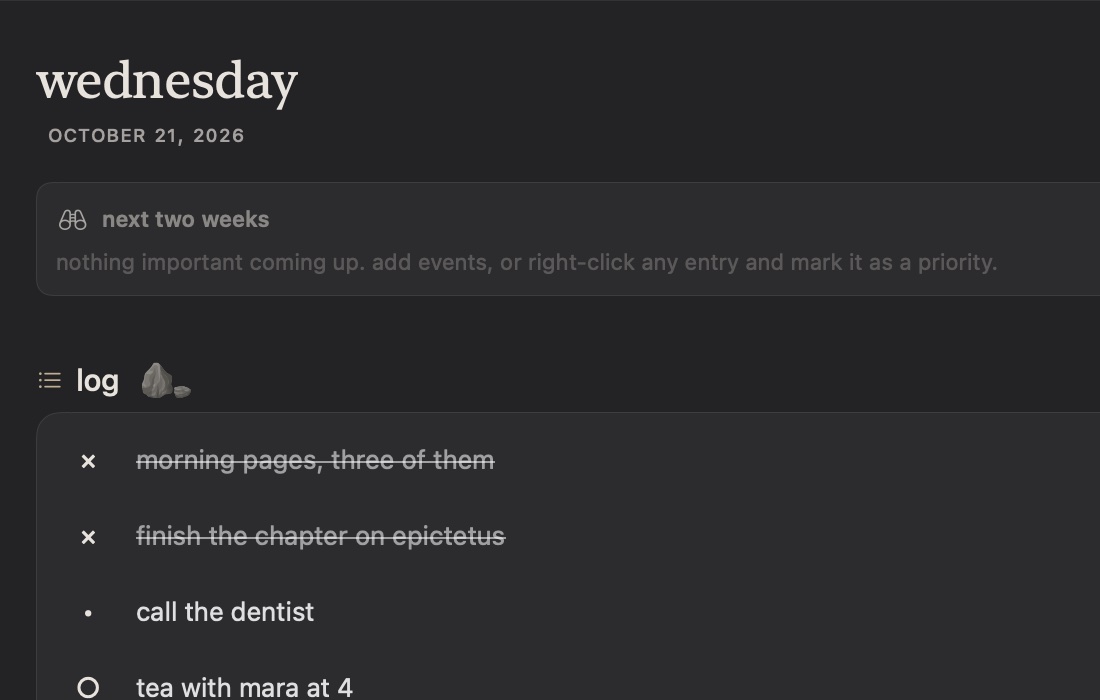
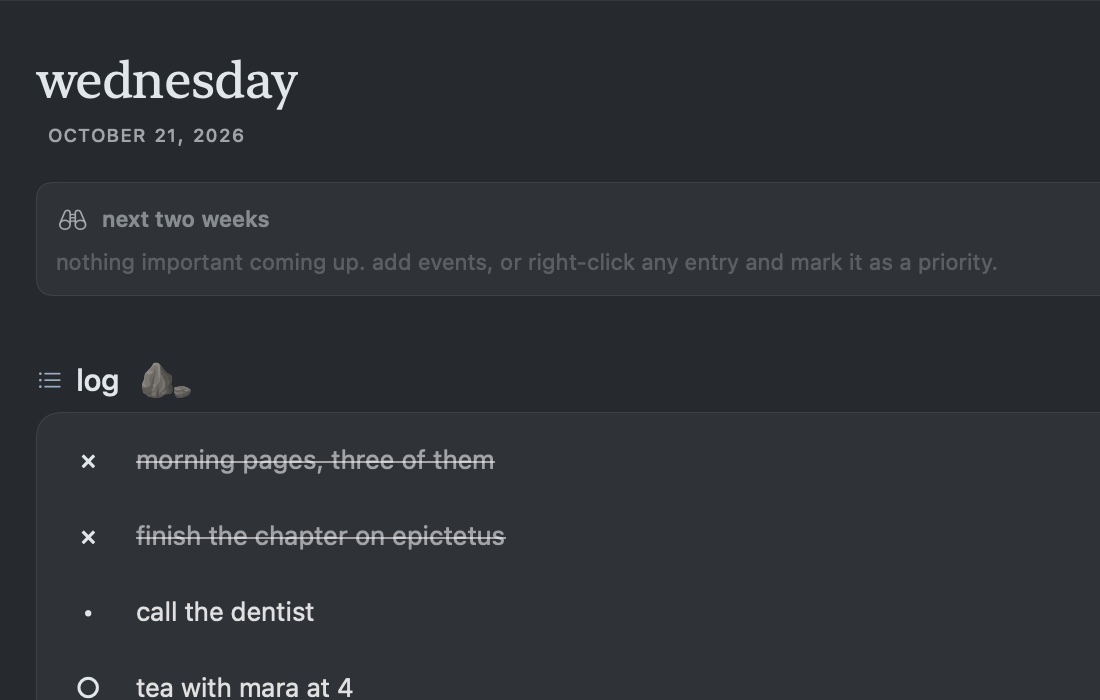
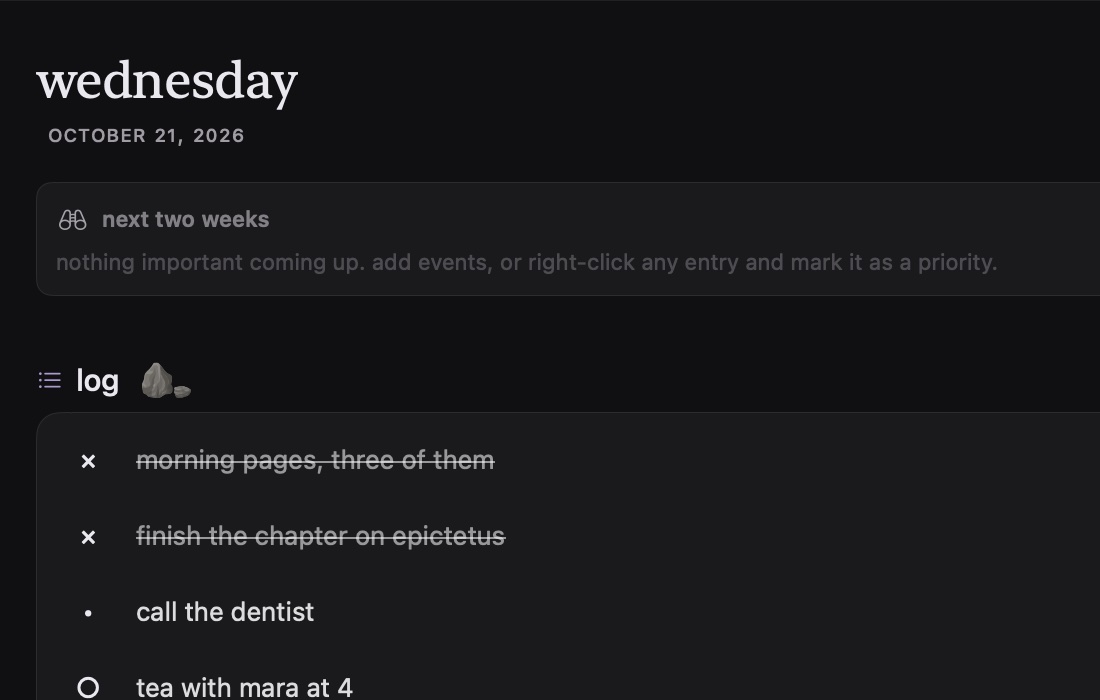
six stone themes. drag to see them all.
every tracker you'd otherwise download

all free. turn on only what you use.

daily log

tasks, events and notes, day by day

trackers

any kind, by tap or by voice

mood & energy

the full feelings wheel, charted

health & medication

symptoms and doses on a calendar

gym

programs, workouts, progress

work & study

projects, focus and zotero

books

your library and pages read

notes & pages

markdown, tables, templates

tarot & oracles

rider-waite and i ching

chores

what's due, and since when

budget

spending at a glance

make it yours

six stones, widgets, opendyslexic

aurum

your tabula is a blank slate, and aurum gilds it. everything you need stays free. aurum adds a few extras and helps keep tabula going. monthly, yearly, or once for good.

  • five profiles: up to 5 separate tabulas (for work, school or someone else), each syncing to your devices. free tabula has one.
  • a year of backups: every week's automatic backup kept for a year, instead of the last four, in your icloud drive
  • make it your own: themes of your own, saved and named; fonts you add; your own accent colour; a photo behind the page; a see-through window
  • community widgets: bring in widgets other people have made and shared, each previewed before it goes on your page
  • the oracles: pythia, hestia and diogenes read your tarot spreads and i ching hexagrams with your question in mind. 5 obols a day (one per question), and a handful, a pouch, a sack or a chest more if you need them
  • the annals: your year in one place: every day you wrote, your moods month by month, habits and best runs, books finished and the cards that kept turning up
  • aurum decks: tarot decks drawn for tabula, only with aurum, as each one arrives. artist decks are separate: anyone can buy those
  • smart deck upload: turn a folder of card images into a tarot deck of your own
  • a year in the trash: deleted things wait a year instead of 30 days
monthlyyearlylifetime · a founding pillar

the people behind it

a placeholder rock for salt

salt

founder · admin

a placeholder rock for katherine lin-chen

Katherine Lin-Chen

concept artist · logo and art

a placeholder rock for nick

nick

finance · logistics

a placeholder rock for pyu

pyu

manager

come along

tabula is in a closed beta with friends. tell me a little about you to join, and say hi in the discord.

join the closed betadiscord